
DPDP Act Covers Employee Personal Data in India
- Feb 24
- 3 min read

When organizations in India discuss the DPDP Act, the focus is usually on customer data. Companies review consent notices, update privacy policies, and secure user databases. However, employee personal data is equally covered under the Digital Personal Data Protection Act.
The DPDP Act applies to all digital personal data processed by an organization. This includes employee records, payroll information, consultant details, and archived HR documents. If your company stores employee information digitally, DPDP compliance in India applies.
What Qualifies as Employee Personal Data Under the DPDP Act
Employee personal data includes any information that can identify an individual. In most organizations, this covers Aadhaar and PAN details, bank account information, salary records, tax documents, medical declarations, background verification reports, performance reviews, and biometric attendance data.
This is personal data linked to identifiable individuals. Under the Digital Personal Data Protection Act, such data must be processed lawfully, securely, and for a defined purpose.
Why Employee Data Is Not Exempt From DPDP Compliance
Many companies assume that employee data collected during employment is automatically permitted for unrestricted use. This assumption increases compliance risk.
Purpose Limitation and Lawful Processing
The DPDP Act requires organizations to collect personal data for a specific purpose and use it only within that scope. Even in employment relationships, data cannot be processed without clear justification.
Retention and Access Control
Employee data should not be stored indefinitely. Access must be limited to authorized personnel. Organizations must define how long records are retained and ensure reasonable security safeguards are in place.
The Visibility Gap in Most Organizations

One of the biggest challenges in DPDP compliance in India is visibility.
Employee personal data is rarely stored in a single controlled system. It is often spread across HR software, finance systems, shared network folders, email attachments, cloud storage platforms, and archived backups.
Over time, duplicate records accumulate and access permissions expand. Without proper data discovery and classification, organizations cannot confidently identify where sensitive personal data exists.
The Role of Data Governance in Employee Data Protection
Strong data governance is essential for meeting DPDP Act requirements.
Organizations must identify where employee personal data resides, classify sensitive personal data, restrict unnecessary access, define retention timelines, and monitor for unauthorized exposure.
Employee data often contains highly sensitive information such as identity documents, financial records, and health disclosures. A breach involving such data can create serious legal and reputational consequences.
Why Employee Data Requires Immediate Attention
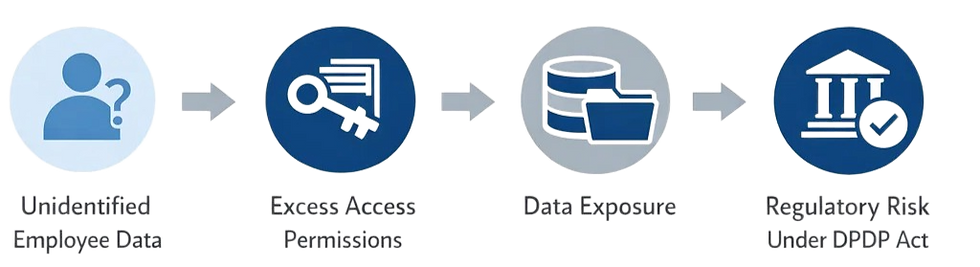
Under the Digital Personal Data Protection Act, employees are data principals. Their personal data carries the same regulatory importance as customer information.
Ignoring employee data exposure creates a significant compliance gap. Beyond regulatory penalties, mishandling employee personal data can damage internal trust and organizational credibility.
Moving Toward Practical DPDP Compliance in India

Compliance under the DPDP Act requires more than policy documentation. It requires operational control over personal data.
Organizations should begin by mapping employee data flows, identifying storage locations, reviewing access permissions, and implementing structured data discovery practices.
Once visibility is established, retention policies, access controls, and monitoring mechanisms can be applied effectively.
Conclusion
The DPDP Act covers employee personal data in India. This is not limited to customer databases or external users.
Organizations that recognize this early and strengthen their data governance practices will be better positioned to demonstrate compliance and reduce regulatory risk.
Employee data protection is no longer an internal administrative matter. It is a legal responsibility under the Digital Personal Data Protection Act.



Comments